

Categories
Recruitment & Selection

Why You’ll Never Find Inject Amongst the Top 10 Recruitment Agencies in Melbourne

Inject will never be amongst the top 10 recruitment agencies in Melbourne.  In fact, we should never find ourselves on a list of recruitment agencies at all, because we are not, in fact, a recruitment agency.  We might look similar and perform similar tasks, but we are a Recruitment Process Outsourcing company – which is fundamentally different.  As a business owner or hiring manager, it’s important to know what you are getting and not getting with each, as this will help you to make the right decision on which option will suit you.

How do recruitment agencies in Melbourne work?

Recruitment agencies generally charge a fee for placement, which means they get paid when a business hires a candidate they put forward.  The agency essentially receives a finder’s fee for their work.  It’s fairly simple in nature – if the business hires the prospective employee then they pay the recruitment agency a commission.  This model places the onus of selection on the business, because the recruiter is highly incentivised to “place” the candidates they have to win their fee.  If they cannot convince a manager to hire their candidates, they generally don’t get paid.

What’s important to understand with this model is that you should not be expecting the recruiter to be fully transparent with you on the process they undertake or the details of the candidate.  It is a fairly standard practice to edit resumes to suit the brief, which makes sense because this is essentially a marketing document for the recruiter.  Think about a real estate agent selling a house – they are obliged to inform you of certain information legally, but other than that they will present each property in the best possible light to gain their commission.

How managers and recruitment agencies engage with each other 

When you engage a recruitment agency, they will note down your requirements and try to place a candidate who fits what you are looking for on paper and who they think you will like working with.  If you want 5 years of experience, skills in a particular software and a quirky personality, then that’s what you will be presented with in most cases.  You should not expect them to challenge your thinking too much.

The recruitment agency model is heavily based on resumes and reference checks.  This is because many managers still assess using these two items and their gut feel on the candidate.  Managers feel good about ticking off in their mind that they have selected on the right basis: the right experience, a former manager who vouches for them and they seem like someone they can work with.

Sometimes managers will ask two or three agencies to bring them candidates, making it a competitive situation.  This approach is based on who can send the right resume first.  Recruiters will forward who they think may be liked by the manager, ensuring they highlight any skills or experience that the manager has mentioned as being favourable.  

One thing you need to accept with many (not all) agencies is because they get paid based on placing candidates, once their guarantee period has been completed (usually 3-6 months) your new hire is at risk of being poached by that same recruiter.  Again, not all of them do this, but you have validated that this candidate was good (sort of) and they have a relationship with them already.  So it’s not uncommon for your employee to receive a call asking them if they are happy or not and if they are open to a new opportunity elsewhere.  The recruiter is often not breaching any of the terms of their agreement and will more likely happen when the employer has an arms-length relationship with that recruiter.  That is, there is no particular trust or equity in the relationship to lose.

Problems with the recruitment agency model

The recruitment agency model works for many people who view their supplier relationships as being a master-servant type of arrangement.  That is, we have a need and you find that person, we will give you a reward.  If we don’t like them, you get nothing.  This is not the case with all engagements with agencies, as some will have strong relationships.  However, you should not blame the agency if they poach your staff when your back is turned, especially if you have treated them this way.

Similarly, the recruitment guarantee can be very attractive for managers who see this as a safety net in case they make the wrong decision.  This works by requiring the recruiter to replace the employee for free if it doesn’t work out in the first 3-6 months.  As with most things, this is not really free because it needs to be costed into the price. That’s fair enough for the recruiter, who may find themselves working for free one day.  The bigger issue though, is that anything that promotes making cavalier hiring decisions is value-destroying for businesses.  If you are spending 3-6 months paying, training, introducing and trusting a person who ends up not working out, you have spent much more money than what the fee cost you and you are now 3-6 months behind in your plans.  Taking a risk on the wrong person just because you get a free replacement is like going to an all-you-can eat buffet that has poisonous food on display.

One other important issue is that the assessment of candidates in a recruitment agency model rests with the employer.  Whilst the agency presents a resume and reference checks, both of these have been proven to have a low level of predictive validity when it comes to performance in the job.  They continue to be highly valued though by many managers, because it is human nature to make decisions based on stories we make up in our heads about people and we value the opinions of others.  Also, many managers inaccurately view themselves as being able to read other people just by talking with them.  Because they are not educated on the many biases that are at play, they make a judgement on how they feel about a person, rather than using a robust assessment process.  

What does a Recruitment Process Outsourcing (RPO) business like Inject provide?

One fundamental difference between a recruitment agency and a recruitment process outsourcing business is that the RPO is an extension of the employer’s team.  This means that the people in an RPO work on behalf of the employer to find and accurately assess the right people, as opposed to looking to place candidates in any employer.  As part of the engagement and contract, the RPO needs to be always acting in the best interests of the employer.  This doesn’t mean they are not good to candidates – in fact it’s quite the opposite.  Because the RPO is the custodian of the employment brand, the requirement for them to treat candidates well is significantly greater.  It is that they are aligned to that employer in an (almost) similar way to an employee working as a recruiter in that company.

One thing that is absolutely essential for an RPO is to behave in a transparent and open manner with their clients.  As they are trusted with finding the right talent for that business, they have to be honest and objective in their approach.  This means they need to be competent in using assessment methods such as behavioural interviewing and psychometric testing.  They need to also have the ability to challenge the thinking of hiring managers and implement strategies designed to find the best performers, rather than getting bums on seats.  Most importantly, they need to tell the truth and not hide things from their clients.

An RPO will tend to manage all or most roles for a business.  This includes situations when there are referred candidates through the employer’s network and they want that person to participate in the same process as everyone else, so that they can assess their fit for the role and company.  They may also manage internal positions so that existing employees have a fair chance of applying for positions internally.  In some cases, the RPO may even work with recruitment agencies in situations where they have been engaged to find candidates in addition to the RPO.

Because the RPO is responsible for managing the recruitment process for a business, they end up working with fewer companies for the same amount of roles.  That is, they will hire more people per business than recruitment agencies typically will.  This means that they forge a close relationship with hiring managers and gain a deep understanding of the business.  They may also become involved in activities such as job analysis, developing job descriptions, talent management and workforce planning.

One final difference that is important to mention is that the payment methods are usually quite different.  Whilst the recruitment agency gets paid a commission for placing a candidate, the RPO gets paid for the work they do.  This could come through an hourly rate or in larger companies it could be a monthly fee.  At Inject, we work off an hourly rate model and also provide a maximum spend budget so that our clients know the maximum cost possible for hiring each role.

Which should you choose?

If you are reading this article, you may have been looking for the top 10 recruitment agencies in Melbourne.  If you have kept reading up until this point, you may be starting to ask yourself what is the right option for your business.  Whether you should work with a traditional recruitment agency or a recruitment process outsourcing business depends largely on what you believe.

List A: How many of the below do you believe?

  1. Years of experience, technical qualifications, and references are high on my list of priorities 
  2. I can tell whether someone will be suitable for a role just by meeting them and relying on gut feel
  3. I believe that recruiters have a database of the right candidates just waiting for me to come to employ them
  4. I prefer to have an arms-length relationship with my suppliers and have them compete with each other
  5. You just hire the right people and let them go, they shouldn’t require much leadership or training

List B: How many of the following do you believe

  1. Attitude, aptitude and behaviours are far more important than how many years’ experience someone has or what another manager who I have never met happens to say about them
  2. I am very interested in learning more about assessment tools that will help identify if someone is the right person for my company and the position
  3. I would prefer my suppliers to be transparent with me about how things actually work
  4. If I work collaboratively with professionals who have the right strategy and process, then together we will outperform the competition
  5. Employee performance is based on both whether the right person is hired and how we lead, manage and train them

Which list did you score more on?  If you scored more Yes’s in List A, then a recruitment agency is for you.  If there were more on List B, then a recruitment process outsourcing (RPO) might be a better option. 

Still unsure?  Please feel free to reach out to us for a discussion on the topic, we would love to hear from you.  

Categories
Recruitment & Selection

What is Recruitment Process Outsourcing?

Small business owners are having to play multiple positions on the playing field of business – this can be a mistake. In an increasingly competitive market, long nights and hard work, business owners are quite often having to perform the role of the accountant, the HR adviser, the marketer all while running their company.

Much like we don’t see the quarterback Tom Brady do anything other than throw a football, business owners should start focusing on what they are good at. Just as we wouldn’t ask Tom Brady to do a 100-metre sprint, business owners should not have to handle every single component of their business, including spending their valuable time recruiting.

That is where outsourcing steps in

Outsourcing is the buzzword of the past couple of years. A business owner is facing competitive markets more than ever, and have to do all they can to win their market share. The key here is to do the things you can do, and leave the things you can’t. We do this through Payroll, HR, and Marketing. Even larger companies like Google are relying on outsourcing of programmers and customer service to help them focus on refining their product.

Business owners are outsourcing tasks like marketing, and this makes sense. Strategies, paid search, SEO, Google Analytics – so many systems and processes needed to be learned, it makes sense that we approach others in the space to handle this process. 

So why not do the same for recruitment?

Recruitment Process Outsourcing 

Simply, Recruitment Process Outsourcing (RPO) is when a company transfers all or part of its recruitment to an external provider. They integrate with your organisation to become an extension to your team. Larger companies have the resources and personnel to dedicate an entire department towards recruitment – RPO’s give that ability to smaller businesses by having a dedicated team that pair with, learn the intricacies of your business, then plan and execute a strategy to bring onboard new talent. Some primary areas we can help include:

  • Identifying and defining new roles
  • Attracting the right talent to fill the role, and where to find them
  • Analyse and assess candidates, finding you the right person for the job
  • Conduct onboarding and developmental sessions 

Recruitment Process Outsourcing and Recruitment Agencies are Not the Same

It is important to distinguish between these two types of businesses. Let me make it clear that there are a lot of good recruitment consultants that work with agencies, though while a dog and a cow both have four legs, they are not the same thing. Similarly, RPO’s and recruitment agencies are completely different animals. Below are two reasons why.

The incentives are different

Recruitment agencies are often sales focused and are remunerated by the commission, while RPO’s are often remunerated through hourly rates or contracts. This is a fundamental difference that affects how recruiters interact with both business owners. 

Recruitment agencies are largely sales-focused, simply because they’re billed on successful placement of candidates into an organization. In other words, their success is measured by the number of candidates they can ‘get through the door’ of businesses in order to get a commission, rather than how suitable the candidate is to the position. 

This focus on speed and volume, motivated by incentive of lucrative commission, motivates a number of behaviours which are not ideal. Being sent countless tailored resumes by agencies hoping one sticks is just one example. 

On a more serious level, this can lead to a lack of transparency and even dishonesty from agencies. Agencies have a clear motivation NOT to share any concerns with candidates with business owners, doing so would jeopardise their commission.

This simply does not exist for RPO’s because the incentives are different. They are usually paid by the hour for the work they do, and are profitable based on developing long relationships with business owners.

These lead to increased transparency. In fact, hiring managers I have worked with are often surprised when they highlight why a candidate is not suitable for them. 

The goals are different

Sales metrics – bums on seats and speed of hire are crucial. Consultants who work in agencies often have a large volume of jobs, so filling a role as quickly as possible, with an eye on getting someone in the role for the commission is crucial. So if speed is what you are looking for, then agencies are your best bet. 

While filling a role is important for an RPO company, the true test of success begins when the person begins. Are they performing the way we thought? Are there any problems? Are they achieving KPI’s? These are the questions that come up that determine how effective the RPO’s process has been. Since an RPO is ultimately an extension of your talent team, trust and flexibility are key attributes.

The focus is on performance, so the process needs to be objective.


RPO’s Recruitment Agencies
Often hourly or contract-based – you get paid for the work you do by the hour Commission incentive structure (often 15-30% of the candidate’s salary)

Can collaborate with you to identify and define the position you need and the right person to fill it, then carry out an end-to-end recruitment process that is tailored to your business’ needs.

Usually only concerned with placing candidates
Success is measured based on the performance of the candidate once they are in the job
Success is measured by sales metrics like bums on seats to receive a commission
Perfect if you are willing to wait for a quality employee
Suitable if the speed to fill a role is the most important concern


There is a place for all services  When it comes to bringing on your next team member, you have an array of options. Recruitment agencies and RPOs alike can be excellent resources for your company and there is enough space for them to work in tandem. 

If you are seeking a competitive advantage, and you know who you choose to bring on can put you a step above your competitors, partnering with an RPO is your answer.

Categories
KPI Performance Management Recruitment & Selection

10 Ways Your Business Will Benefit from Position Descriptions

When we say the words “Position Description”, for some it can conjure up positive feelings, such as clarity, accountability and alignment.  For others, it feels like bureaucracy, being boxed in and doing paperwork just for the sake of it.  There are those of us who like documentation, whilst others have an allergy to it. I am neither a documentation nor non-documentation person – I am a person who enjoys good business practices that add value.  

Let’s explore where the value in position descriptions lies and whether or not it is valuable for you.  There are 10 benefits that I have broken up into 4 categories.


Hiring the right talent

1. Position Description can give you a better chance of selecting the right person

Take the job titles of Business Development Manager, Customer Service Officer or Marketing Manager.  If you want to increase the chance of hiring the wrong person, be unclear about what the job is.  A clearly defined position description provides what someone needs to be great at, what they need to be good at and what is irrelevant. For those people who just hire people based on who they like, then this may not matter.  But for those looking to bring high performers into their business and are using valid assessments, defining the position is critical to those assessments working.

2. Position Descriptions can help you to attract the right person

What am I signing up for?  If it is not clear what the job is, the high performing candidates may opt out of your job offer.  This is because they are the type of person to carefully consider their decisions and it also shows that you haven’t put in enough effort to complete a PD.  If you can’t be bothered with that, what else will you not be bothered to do?


Operational Excellence

3. Position Descriptions can help to reduce double-handling or tasks slipping through the cracks

When two people have the same task in their position description, it can result in double handling or worse yet – group think.  Whether it’s no one’s job or everyone’s job, having clarity over whose job it is, helps to get over this hump of confusion.  Similarly, the assumption that a task sits with a person who doesn’t know it’s their job (or is in denial about it) can create a lot of noise around the task.  

4. Position Descriptions can assist with reducing excessive hand-offs

By completing a position description exercise that looks at a business holistically, you can identify the best way to organise tasks for the greatest efficiency.  There are often tasks that have evolved over time as the business has grown and in many cases the person completing it is only doing so because that’s what has always happened.  The impact is that they become a bottleneck for everyone else, resulting in poor customer experience. 


Performance and Development

5. Position Descriptions can help with people performing the position you actually want done

Most of us like doing certain things in our job and dislike other parts of it.  There are tasks that we may not even complete at all.  It’s only once we review what the position is meant to be and compare that to what is taking place right now, that we identify the gaps.  Alternatively, where we have a clear position description from the start, the conversation can focus more on what the High Value Activities are within that position that each employee should be focused on to best help the business.  Once we have developed the HVAs, then we can talk about how they can find their way into the calendar every week.

6. Position Descriptions can form the basis of competencies and development

What should be in the training plan of a new starter?  If a position description is clearly defined, it creates a roadmap for what you should be training people one.  You can then circle back to it to check in and see where they are at with their development.  The tasks should all be visible and accessible, which reduces the awkwardness of discussing competency in a role.  Similarly, for those aspiring to the next level, a position description can help provide clarity to a junior employee on the gaps they need to close.

7. When dealing with performance matters, Position Descriptions can be a reference point for what they are required to do.

One of the most common performance issues that exists across all organisations is this: the employee wants to do part of the role, but not all of the role.  Why?  Because they don’t like doing certain aspects of the role and they lack the motivation and/or competence to overcome this hurdle.  The position description can help with everyone being on the same page as to what the job is.


Risk and compliance

8. When looking at whether someone is physically able to perform the inherent requirements of the role, Position Descriptions help to define what this is.

Some businesses will have a process where they ask a new employee to provide information on any pre-existing injuries that would prevent them from performing the job.  This is usually the case in physically demanding positions, although the same can be done for any position.  The trouble is that their method for doing so is not robust, as they have not defined the inherent requirements for the position.  If I have a shoulder injury and you are clear that the inherent requirements of the position require lifting above my head, then it is harder to deny than if you don’t be explicit about it.

9. Position Descriptions are referred to in most employment agreements

This is an obvious practical part of offering a job to an employee.  Your employment agreement (contract) will refer to a position description.  If there is not one that exists or if it is inaccurate or vague, then it makes for a less robust agreement.  Also, whilst modern awards can sometimes be confusing at the best of times, if you haven’t got a position description to compare it to, then it makes it that much harder.  The impact of getting this wrong could result in being in breach of a modern award term or potentially underpayment.  These breaches can come with fines and stress that you don’t want to be getting.

10. When restructuring and having to justify why a position has changed (or not changed), the Position Description forms the basis for that justification

You can’t plan for restructuring or redundancies that are going to take place far into the future.  The point at which you realise you need to take this action is too late if you don’t already have a position description.  If you are making the argument that a role hasn’t changed substantially and therefore would not trigger redundancy or conversely if you are arguing it has changed sufficiently to trigger a person’s position being at risk, if there is no starting position your argument is more open to challenge.

Summary

Not all position descriptions are created equally and not all processes for developing position descriptions are created equally.  Don’t mistake your borrowed version from your friend as having anywhere near the same impact as doing it properly.  By investing in the right expertise, as well as your time and focus to get your position descriptions correct, you will save yourself headaches in the long run.  You can choose to wait until you have learned the lessons directly, or else invest the time and effort now knowing that the above is true, reaping the rewards for years to come.  It’s not about whether you love documents or not – it’s about good businesses practices that help you achieve what you want.

Categories
Business Strategy KPI Performance Management Recruitment & Selection

Why you need to use psychometric testing when recruiting

People are like icebergs. You know the old picture – the one where the mass of the iceberg is hidden from view from those looking at the iceberg from the surface.

Much like the mass of an iceberg, the ability, drives, and motivations of people are usually hidden deep below the surface. Psychometric assessments give us a look at what is underneath the surface level of a person – it gives insight into what drives them.

Why is this important? 

At the end of the day, the primary goal in the game of recruitment is prediction – that is, how certain are we that Joe Bloggs is suited to the role? Can they adapt to the demands of the organization? Do they have the framework to cope with the busy nature of the role? Can they manage a team? Can they perform under aset of time limits? Or, do they enjoy selling?

While a magic crystal ball would be the only thing thatcould give us 100% certainty, phone interviews, behavioural interviews – and yes, even reference checks – can give us some insight into the above questions. Though none quite get under the surface of who someone is more than psychometric assessments.  


Not all recruitment measures are created equal

We have probably heard of a questionable candidate who did not work out in their new role. I hear of this all the time. The first step is to sit back and ask how they got the job in the first place, we see red flag after a red flag in the interviews, but their years of experience and outstanding references got them ‘across the line’.


References and experience are the least valid measures.

We connect with references because they are other people who know the candidate – surely they know best, right? The reference, caught off guard and not wanting to talk ill of their old workmate, says they were outstanding (despite always being late and nevermeeting deadlines).

And the years of experience they have in the industry, surely, they know how to perform? Though this ignores the fact they may have been flying under the radar and underperforming for 5, 10 or 20 years!

Not all tools will have the same ability to predict how a person will perform – yet we often put more weight on less valid assessments like reference checks and experience.

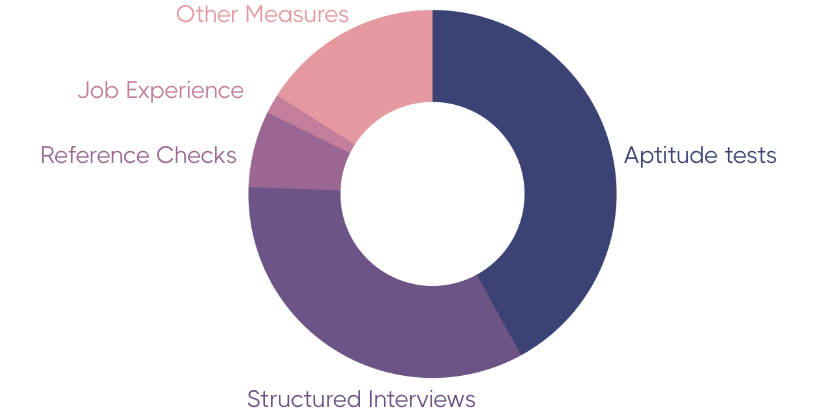
In a 2016 article called “The Validity and Utility of Selection Methods in Personnel Psychology: Practical and Theoretical Implications of 100 Years of ResearchFindings” Schmidt found that general mental ability as measured through psychometric assessments is the largest predictor of job performance. 

In fact, many assessments have been put to the test – but which ones come out on top in terms of prediction? Below is an outline of just that.


The above picture puts some interesting perspective and challenges the norm; reference checks and experience make up a small part of the pie when predicting job performance. If I had a dollar for every time, I have seen the dreaded 5 years’ experience requirement, I would be rich. And if you’re a business owner, you’d likely be just as rich if you had a dollar for every time a recruiter approached you with a candidate with some impressive number of years in or had great references.


These are the least valid measures of performance, yet we often put the most weight on them. We have been focusing on the wrong thing for far too long.

Job experience can be important, however, in my experience far too much weight is placed on this. If you are spending time focusing on experience, rather than what psychometric tests measure (like ability and personality traits), you are leaving yourself open to uncertainty and perhaps worse; missing the opportunity to bring on someone who can change your business.

Most people make supposed informed recruiting decisions and have the nervous wait to see if they have or have not made the right decision. When they are used correctly, and of course, in combination with other steps like structured interviews, psychometric assessments are a useful tool that can cut through the BS and get you that little bit more closure and certainty on your next recruit.

Categories
Business Strategy KPI Recruitment & Selection

What Should Small Businesses Look For When Recruiting?


I’ve seen business owners approach hiring like someone approaching a buffet. It can be tempting to grab what you can in a hurry before anyone else gets there. 

Whilst it’s important to move quickly when you’ve found great talent, it’s also worth slowing down to think strategically about what the most important characteristics in a successful hire look like for your team.

Don’t fall into the trap of hiring someone quickly, to plug a hole and sacrifice talent. That’s like grabbing the bread rolls then missing out on the pork roast at the end of the table because you were hungry and didn’t want to wait.

Deep down, you already know that longer-term, hiring the wrong person costs time, money and resources you can’t afford to waste.

You might be thinking about which soft or technical skills will be successful in your role, which is a great start. Inject looks past characteristics like industry experience and detailed product knowledge, to the behaviours. We work on the premise that past behaviour is the most accurate predictor of future behaviour.


Don’t fall into the experience trap in recruitment

You hired someone with industry experience, glowing references and they said all the right things in the interview. Bulletproof, right?

Just months after their first day, other employees are complaining about the new recruitment – they’re making decisions without consulting others, causing friction with staff and not following company procedures.


How could this have happened when everything indicated they’d be a great hire?


Whilst it can be easy to believe that years of experience in your field will result in successful hiring results, you may have missed others, just as, if not more significant, indicators they weren’t the best fit for your business.


Questions you need to ask yourself in your next hiring process

There is no one right answer, however, depending on the particular role – senior, entry-level, graduate, sales, manager… to break it down, below are some questions to ask yourself through each stage of the recruitment process when hiring your next employee:


1. Resume

Seeing through the resume and being critical about the person who wrote it helps create a broader picture of why them and why this role.

  • If you asked them to include a cover letter, have they done so? Has this person addressed you or the company and specifically mentioned what appealed to them about the role?
  • Is the application free from spelling typos and errors? This can be a challenge to spot if you’re receiving resumes from an agency, as they can often be formatted.
  • If they don’t have industry experience, does their work history make sense for them to transfer into this role? E.g. similar tasks, similar job description, transferable skills. Does their career path make sense? 
  • Have they job hopped around? Have they gone into management then moved back down, or moved into sales and then back to admin? 


2. Interview

Being objective in your interview style allows the candidate to give you a more transparent view of their abilities, unclouded by their industry experience or how they spoke on the phone.

  • Are you giving candidates the best chance of demonstrating their abilities or are you asking them to give answers you want to hear? Asking open-ended questions rather than leading questions allows the interviewee to answer unbiasedly. 

E.g. “Tell me about a time when you had to complete multiple tasks at once.” Rather than “So, do you use a to-do list and schedule your calendar to ensure you keep track of your time?” The answer is more likely going to be accurate and honest, rather than ‘yes’ or ‘no’.

  • Are you using behavioural interviewing techniques? A quick Google search shows that there are multiple articles citing strong validity between behavioural interviewing and predicting job performance.
  • Did the candidate ask specific questions about the role and company, appearing genuinely interested and motivated?


3. Psychometric Testing

Are you utilising evidence-based assessment methods like psychometric testing? 

There are many different tests that assess a candidates’ natural strengths and behaviours, giving you a clearer picture of whether or not they’ll be a good fit for the role.


4. Reference Checks

Reference checks aren’t the most valid form of assessment, but we can use them to confirm what we’ve observed from the rest of the hiring process.

  • Is the referee a direct manager or a colleague? 
  • Did they pause or stumble at any questions you asked? Did you probe enough on areas you were unsure about?
  • Is the referee recent or from 10 years ago? Have they provided their personal email and phone numbers or their work contact details?
  • Have you cross-checked this reference on social media or their company website to confirm they are who they say they are?


5. The In-Between

What we mean by this is the time in between formal interviews and assessments. When the mask is off and the candidate is relaxed. You can find out a lot from when people believe they aren’t being assessed or measured. 

  • Has the candidate been fast with their response, flexible with their availability and clear with their communication over email and phone?
  • Do they seem genuinely interested in the role? Do they have a positive attitude?
  • Have you given them the opportunity to provide feedback about how they’re feeling about the role? 
  • Have they reacted negatively toward participating in certain assessments or parts of the process?


Transform your business with the right hire

If you are currently hiring, it’s worth slowing down and asking some of these questions. At Inject, we work with small-medium business owners and understand that hiring a poor performer can destroy entire teams’ productivity and morale.

We also know and have seen firsthand how a high performer can transform a business.

We don’t leave your hiring to chance because we focus on the attitude, aptitude and behaviour of candidates, so you know exactly what you’re getting. We work with you to ensure your business has the right people, in the right roles, at the right time. 


If you think our approach could work for you, please contact us.


You may also be interested in our eBook – Building a High Performing Team on Purpose, for more insights. Chapter 5 is on talent management which you can read here.

Categories
Business Strategy Recruitment & Selection

Are your managers accountable or relying on reference checks?

Our lives are engulfed with social proof

Not long ago, we went for a stroll as a family to some nearby shops and I wanted to see if there was a better croissant on offer.  I looked up a French Bakery that had an average of 4.3 stars on Google. Fantastic, yes?  

No. These croissants were plain, dry, and overall unimpressive.  So how did it get a 4.3-star rating?  There were many things wrong with the decision-making here:

  • First of all, who are these people giving these ratings and why do I place any value on what they think?  
  • What were the criteria they were using to give this rating?  Was it the same as mine?
  • Were they buying a croissant? Or did they buy the sausage roll?


We love social proof.  How much do we rely on it these days?  Let’s look at some of our regular activities in this present era:

  • Need to find a new place to eat?  Look at UberEats, Google and Zomato ratings
  • Looking to buy a new drill for odd jobs around the house?  Check out product reviews.
  • Want to make a purchasing decision on Amazon?  Go straight to the reviews.
  • Vivino for wine
  • The list continues…

What’s wrong with this?  Well, not much really when we want a fast and approximate answer to something that has low impact.  The value of getting quick guidance is high and the relative impact of this guidance being wrong is low.  

This doesn’t mean that a 4.3-star bakery can’t also be fantastic.  The issue is that we come to expect social proof as being the truth.  But it’s generally ok, as the impact though of buying a pastry for a few dollars that weren’t to your liking is very low.  We move on and then have new content for our blogs, so it’s not all bad.


recruitment-reference-checks)

Too many managers rely on social proof for significant decisions

So how does this analogy relate to management accountability and hiring decisions?  Well, I’m glad you asked…


Reference checks.  

Have you or your one of your managers ever been really excited because you heard a glowing reference check for a prospective employee to join your business?  If your answer is “yes”, well that’s ok – there is nothing inherently wrong with that.  

Answer this question: have you or any of your managers ever referred to how the reference checks were really strong, yet wondered how you ended up with a bad hire anyway? 


We’re now getting closer to the problem.  

What took place was that you heard from a manager in some other company, who you don’t know, who doesn’t care about you and mentioned that the person you’re looking to hire was great.  They don’t know much about your company or the position you have on offer.  What are their standards as a manager?  We all know there are plenty of managers who are not good at assessing performance or accept mediocrity at best. 

So when a hiring manager relies heavily on reference or backgrounds checks and their gut feel as their main way to assess a candidate, what does this say about them?  Don’t get me wrong, you should definitely still conduct reference checks and they can provide value.  It’s just that they should be conducted at the right point in the recruiting process, not the sole contributor to a hiring decision.


Managers who lack accountability use social proof as an excuse for poor decisions

Besides the lack of knowledge of different methods of assessment, if a manager continues to mention reference checks when a new hire doesn’t work out, they are also lacking accountability. The impact of eating a poor croissant is low.  I can make a decision based on social proof and whether or not I like the look of the place.  But the impact of a poor hiring decision can be astronomical.  Yet very often we use a similar method for making such a major decision.

“The references were good!”

“How are we supposed to know…?”

“You can’t pick it, sometimes it just doesn’t work out…”

“Everyone makes a bad hire at some point..”


Do you know one of the biggest telltale signs of a lack of accountability?  It’s not admitting that you have a problem in the first place. 


Accountable managers want to learn how to get it right

Taking accountability means ensuring success, or at least taking the right type of action to get there.  Shift your mental model away from hiring as being mostly luck or gut feel and accept that there is a successful process you can learn.  This is hard to do. But this is what accountability looks like.  

Whether you are buying a croissant, making a croissant or hiring for your team.  If it’s important to you, you will find a way to consistently deliver the right outcome.  If it’s not, you simply rely on gut feel and social proof.  Challenge your management team to do it differently.  Don’t accept the perplexed look when a bad hire with good references doesn’t work out.  Demand a different approach.  Lead the team in a new direction and let those who refuse to change start contacting their old references to prepare for their next victim.


Other Resources You Might Find Helpful

I wrote an 8-part ebook recently for business leaders who believe their people are part of their growth and competitive advantage.  It’s called How to Build a High Performing Team On Purpose.

If you’re interested to learn more about Inject’s interview and recruitment process and how we can help your business, feel free to connect with me on LinkedIn or contact us here.

Categories
Business Strategy Recruitment & Selection

Chapter 2 of Building a High Performing Team On Purpose — Your Business Strategy

This is Chapter 2 in the 8 part self-guided series, Building A High Performing Team On Purpose.


There is a scene in Seinfeld where Jerry and George talk about how people like to say “salsa”. 

In business, “strategic” and “strategy” are in the same bucket. A lot of businesses believe they have a strategy. Most management teams use this term loosely and will reference their plans or a set of initiatives designed to improve the business as their strategy. They may describe “strategic goals” as achieving 20% growth year on year or similar generic outcomes.  It is usually when they are talking about improving a part of the business, but this doesn’t mean they are working on a strategy. It could just be an operational improvement, which can be valuable but is not a strategy.  

It’s important to get the language right because this reduces the chance that we are kidding ourselves and confusing others. One of the simplest definitions of business strategy is “where you are going to play and how you are going to win?”. What I believe is just as important is where you are not going to play and what is not going be pivotal to winning.

I’m not going to go into too much depth about strategy here, because there is a lot that would need to be written and that’s a different topic. However, strategy in building a high performing team on purpose is highly relevant. This is for three distinct reasons:

  1. If you have the discipline to say what you are not, then you have a better chance of being what you want to be
  2. If you only deal with customers who value what you do, then the measures of success will be aligned to your strengths
  3. If your organisational design is aligned to your strategy, then the trade-offs will allow you to have better talent in pivotal areas

I’ll explain this as we work through this chapter.  


1. If you have the discipline to say what you are not, then you have a better chance of being what you want to be.

Defining what you are not is more powerful than defining what you are. Companies will often talk about being the best such-and-such company in the world. For instance, we are going to be the best motor vehicle company in the world! What does that actually mean? That’s like being the best runner in the world. A sprinter is vastly different to a marathon runner. Running the steeple chase is different from the 100m hurdles. Rather than saying you are a 100m sprinter, say you are not a marathon runner.  

It’s not about being generically better than everyone, it’s about being specifically better in a specific way to a specific group of people.

There is a very simple exercise that I conduct with business leaders in order to get the discussion going on strategy. It goes like this:

You have three areas of focus below:

  • Operational Excellence: How consistently your processes deliver your product or service to your customers.
  • Customer Intimacy: How much you know the intricacies of each customer and deliver value to their specific needs.
  • Product Innovation: How innovative your products or services are when compared to the rest of the market.

You have 11 points to allocate based on what you want your business to be best at.  

For example, you could go: 

  • 3 on Operational Excellence
  • 5 on Customer Intimacy
  • 3 on Product Innovation

This means that your execution and products are at the standard of the industry, but you are highly tailored in your approach to meet the specific needs of customers. If you switched the 5 from Customer Intimacy to Operational Excellence, you would then be reducing your tailoring to lead the industry in excellent delivery.

So, what do you choose? If you have several business partners, it would be worthwhile completing the exercise separately and then comparing notes.

There are many models and to develop a proper strategy you need to go much deeper than this. Completing this exercise doesn’t mean you have a strategy. It is a simple way to look at what you are not going to be.  

The message is to define what you are not and have the discipline to apply this. This gives you a better chance of being what you want to be.


2. If you only deal with customers who value what you do, then the measures of success will be aligned to your strengths

Another simple exercise I like to perform is to draw a picture of your target customer – down to the level of detail of what they had for breakfast. Now do the same with your “enemy” customers who kind of look like your target market but give you a world of headaches. What your target customer value should align to is what you are striving to be best at. What your enemy customers value should be irrelevant. Energy trying to please your enemy customers takes away from building capability to serve your target customers.

Some of you might be nodding your head right now but are wondering how this relates directly to building a high performing team?  Well, the first is that a high performing team is a generic term that needs to be applied to the specific. A high performing team in what? Basketball? Football? Even within the same sport, is it a run and gun team who plays at a fast pace or is it a team that has strengths in hustle and defence. Whilst all teams need to be somewhat proficient in everything, the better teams are outstanding in one or two areas and all players are geared towards this strategy.

Transferring this across to business, if you have a team who are all great at selling high value products and deeply understanding customer needs and if you have processes that are set up to deliver to the high end market, then if you take on a lot of low margin high volume deals then this is likely to cause stress and frustration for your team and not play to their strengths. 

Who likes doing their best and finding that no matter what they do, they can’t seem to win? Well, not many people I would think, but certainly not high performers. High performers cannot stand to be in a position where they are not able to be a high performer no matter what they do. Those people will become disengaged and eventually leave.  

If your strategy is not clear and/or you are not disciplined enough to focus on your target market, then you will have dilution. If your business is diluted across a broad range of customers that includes your enemy customers, your people will be feeling increased stress dealing with unhappy people.  

Here is the kicker: 

One thing that causes stress for your people is dealing with unhappy customers. Who likes dealing with people telling you that you stuffed up? That you are no good? The additional re-work that takes place also causes stress, because people are working longer hours and working on things that sap their energy. The role that they signed up for may not be the role they want.  Fixing the issues may also not be their strength, as opposed to delivering value to your target market.

The stress that this creates for your employees will build tension between them and your managers. If your managers feel powerless to change it, they will become disengaged. Your business will be less profitable, and you will not be motivated to invest in sourcing more business in your target market because you’ll be busy putting out the fires caused by your current unhappy customers and employees. 


Conversely…

If you are delivering value to your target market and not trying to please your enemy customers, you have a competitive advantage in attracting and retaining talent. You can offer talented employees an experience that is taking full advantage of their talents, without placing them in situations that highlight their weaknesses. You can offer an enjoyable workday filled with happy customers who love what they do. This is what a good Employee Value Proposition should always include, which I will touch on in later chapters.

Having a clear strategy that allows you to deal only with customers who value what you do, gives your people a better chance of being high performers and gives you a better chance of attracting and retaining high performers.


3. If your organisational design is aligned to your strategy, then the trade-offs will allow you to have better talent in pivotal areas

The first two concepts of this chapter are on having a clear strategy, focusing on delivering value to your target customers and avoiding your enemy customers. If you have bought into the concept of this being an important part of building a high performing team on purpose, then what are the steps you need to take to enable your team to deliver on this value?

Some of the questions worth asking to help define this are:

  • What value do we want to provide for what type of customer? What is the pain we alleviate and why do they care?
  • What does my business need to do specifically in order to deliver this value? What are the deliverables and in what way?
  • What capability does my business need to have in order to achieve these deliverables?
  • What part do my people play? What do my people need to be best at? What can I live with them not being best at? What do they not need to be good at at all?  
  • What are the positions that are going to be most pivotal in delivering my competitive advantage?
  • What are the behaviours I am looking for in my people that helps them be the best at that thing? What do they need to know? What else do they need?
  • How do they need to best work together? How do they best work with customers and suppliers?

To give you an example, I founded a recruitment company called Inject, which focuses on hiring talent with the right attitude, aptitude and behaviours. The target market is small-medium business owners who are challenging their industry or delivering a premium solution to their customers. The capability required is to have strengths in analysing people, thinking outside the box in terms of sourcing strategy and knowledge of what constitutes high performance. 

There is zero requirement to be good at cold calling, as this is not what the business does at all. There is no requirement to be able to sell a candidate. There is a requirement to present a complete assessment of a candidate accurately and transparently. The way they need to best work with their customers to learn deeply about what it’s like to run a business and how the impact of one poor performer can bring down a small business. To properly empathise with the business owner and present information that gives them confidence there is an alignment.  

The talent strategy at Inject is starkly different to most recruitment companies, therefore the target market for talent is completely different. What people are hired on, what they are trained on, what they are measured and rewarded on is completely different. There is no competition for talent because the overlap of what they do is so small. There is nothing particularly wrong with traditional recruitment companies, it’s just that there are thousands more like them.  

Are you utilising your labour force in a way that creates an inimitable competitive advantage, or have you become much the same as everyone else?

The capability to deliver your strategy comes from your people. If you don’t have a clear strategy, then you are just trying to hire generally good employees. You aren’t looking for them to be great at a smaller number of things. Then if you place these people in situations where your company is not best at any of those things, then they are constantly dealing with unhappy customers. When you are dealing with angry people each day and feel powerless to do anything about it, you end up unhappy yourself and don’t deliver great service.

Your talent strategy also needs to be a “strategy” and that means trading off one thing for another. It’s not about generically good. Work out what you are turning up and what you are turning down, what you are investing in and what you are leaving to one side. Having a talent strategy that supports a business strategy gives you a much better chance of building a high performing team on purpose.


I recommend you take the following three actions:

  • Clarify what your strategy is and make it crystal clear. Beware of confusing your strategy for your plans, initiatives and tactics. Be clear on the trade offs you are making.
  • Be disciplined about who your customers are and as much as possible only deal with those who are truly in your target market and are equipped to serve. Doing so will set your employees up for success (subject to making sure the business operations are actually set up to properly deliver on your strategy).
  • Build your organisational design off your strategy and by doing so define the capabilities you need to be great at to deliver your strategy (more on this in the next section).


You can read the first chapter of Building A High Performing Team on Purpose here.

Categories
Recruitment & Selection

My team is returning to work… now what?

What last week’s announcement means for business owners and their employees.

The three bears

With the prospect of teams returning to the office after working from home for the last two months, there’s a lot of people who think pre-Coronavirus habits and routines will just fall back into place like before. 

As a business leader, there are common problems we’ve found, questions that you should be asking yourself as the transition from survival back to growth begins. 

You’re going to have little questions that need a big focus from employees. Questions that might seem little to you, but could be keeping one of your team up at night with worry.

You’re going to have bigger challenges that require time and a slower, more in-depth focus.

And you’re going to have questions in between. Those nagging questions that keep niggling in the back of your mind, that if you don’t give time to now, you’ll potentially miss the boat to take full advantage of the opportunities that have arisen from this crisis.

We’ve likened these questions to the three bears and compiled three, escalating areas for you to consider. You’ve got the large bear, the middle bear and the baby bear. 


Baby bear: The small, one word answer questions

Starting with the baby bear, one question we’ve been hearing a lot from clients is what if people don’t want to come back? What if they’re too cushy at home and what does this mean for their businesses? For example, what date are we returning to work, and, what if we don’t want to come back to the office?

Whilst it’s not a big issue in our mind, as an owner, it might be a large one in their minds. There’s these little questions that are going to be impacting your employees’ mental state. 

The first thing is to be mindful of the fears or perspectives of employees coming back. If they say that they are scared to come back, saying ‘I don’t want to come back,’ your initial reaction might be to dismiss it. However, you’re better off pausing and listening to them, seeking to understand where their fear is coming from. It makes sense to find out why they’re uncertain or worried, and influence their decision rather than to have a heavy hand and tell them directly. 

For the sake of your employees’ peace of mind, you’re better off actually treating that smaller bear like it’s a big bear because that’s how they view themselves and making time to answer their questions, however minute they may seem to you.


Middle sized bear: Making the most of the changes

You might be transitioning back to coming into the office after many weeks working from home. So, how do you optimise the changes for the long haul? How do you extract the efficiency that many people have said they’ve gained with less interruptions and more thinking time when working from home.

At the same time, there is increased isolation and the brain drain from video conferencing. How do you maximise the best of both situations so that people are still getting the social interaction from work whilst also getting time at home, where they’re more efficient?

There’s no doubt that the rules around working from home have changed. There were many that used to be unsupportive of it. But the restrictions from the pandemic have normalised working from your kitchen table or home office.

Set aside some time in your calendar to think about how you’re going to balance the two. Are you going to let it evolve on its own? Or are you going to deliberately implement a particular approach which utilises the best of both environments for your team?


Big, grizzly bear

The last question can often be grizzly, but once you’ve confronted it and formed a plan… Well it’s probably still grizzly but a lot less likely to kill you or someone else.

From the last three months, where is the opportunity for your business model, your industry and how you serve your customers?

You may have had to fundamentally change to keep operations afloat or the environment has changed and you haven’t realised. It’s time to reflect on what opportunity is out there for a business model adjustment, or a pivot, as they call it in the entrepreneurial world. Now, it’s more challenging for a larger business to pivot so we’re calling it an adjustment instead.

But how does a business model change and what does that mean for your employees or your organisational design? 

Do you have the right roles and capability to actually fulfil that business model?

Maybe you have the right people, but they’re not equipped. Maybe you don’t have the right people. 

There’s questions here that are big ones to tackle and can be scary to start thinking about. But if you don’t think about them now, your competitors are going to be thinking about them and they’re going to be taking advantage. Enough with the bear analogy, but you might find yourself in some trouble.


What are you going to tackle first?

We’re considering three matters: small, medium and large issues to think about post COVID19. 

The small matter is how to get people to come back into the office. Which sounds simple, but could be the biggest issue in your employees’ minds.

The mid-sized matter is around how you find the balance between working from home productively and building the social connection that comes from being present in the office.

Finally, our big, grizzly matter is to not ignore your organisational design. Do you have the right capability in your business to serve your customers in future?


If you enjoyed reading this piece, you might also like our blog on Building a High Performing Team on Purpose.

Categories
KPI Performance Management Recruitment & Selection

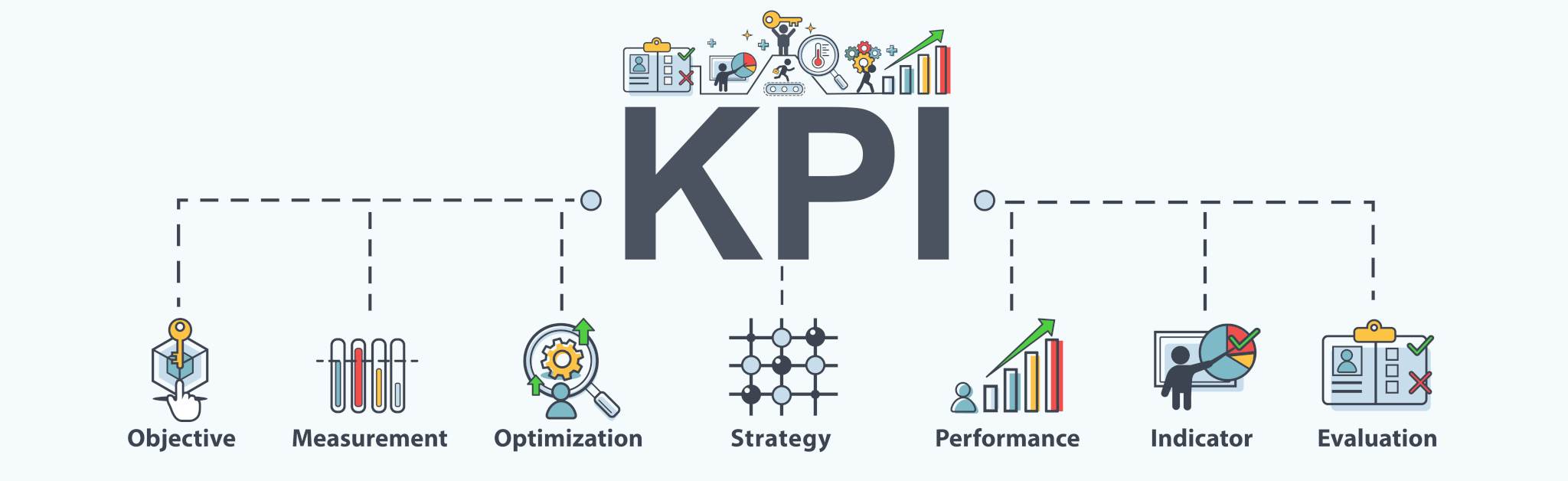
Why are companies moving from KPIs to OKR and whether you should too

First off…what’s wrong with KPIs?

When you mention the term “KPIs” (Key Performance Indicators) in most companies, you get a mix of reactions.  Managers feel a sense of energy because the certainty that having hard measures in place helps them to reduce the debate about performance.  Staff feel a sense of dread and anxiety, eye-balls rolling into the backs of heads in sequence like falling dominoes.   

Why does this seemingly ever-present dynamic continue to exist in so many companies?  Well, the thing is that KPI has become a swear word in many people’s worlds. It’s not that there is anything inherently wrong with KPIs.  It’s like the word Kit-Kat – this is generally a positive thing, right? But if I poked you in the eye with one over and over again, eventually you will start to want to break my fingers.

The problem with KPIs is that they are fraught with danger.
Below are the many traps managers fall into when developing and implementing KPIs:

  • They measure what is easy to measure, resulting in trivial matters being measured whilst more important areas are not tracked
  • They don’t involve their team in developing them, so staff feel that they KPIs are a punitive and controlling mechanism
  • They lose interest in them, so their lack of follow up proves them to be mostly useless
  • They are not aligned to the strategic and operational priorities, therefore not supporting the business objectives
  • They are not measurable, therefore resulting in a vague representation of performance
  • They have too many KPIs, therefore making the system too difficult to track and manage
  • They believe that the KPIs will do their job for them, so their discussions with staff are at best a waste of time, and at worst are highly demotivating

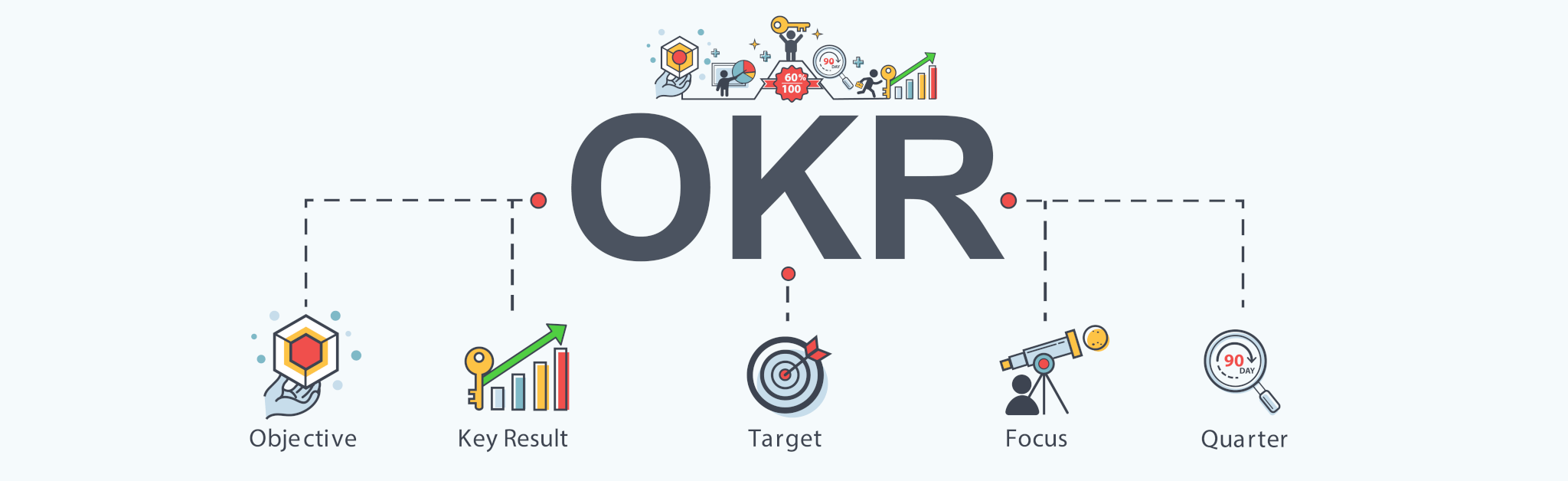
The end result is that a lot of KPI programs are abandoned, because they are too hard.  An alternative concept that is gaining more exposure lately is to use OKRs instead of KPIs.  OKRs stands for Objectives and Key Results. Now let me tell you, changing the acronym doesn’t mean people will make the same mistakes as in the past.  However, this model has a few differences to KPIs that might just give it a fighting chance. Also, sometimes bringing in something new that doesn’t have the same baggage from the past may help both staff and managers approach performance measurement with a positive mindset. 

What’s the difference between KPIs and OKRs?

What are KPIs?

KPI are measures that are tracked on an ongoing basis.  KPIs can be measured at a company level, divisional level, team level or for an individual employee.  In theory, there should only be a small number of KPIs:
Examples of KPIs are:

  • Cost per acquisition – how much it costs in search engine marketing to achieve one acquisition (whether a lead or sale depending on the goal) 
  • Delivery in Full and on Time (DIFOT) – manufacturing measure of producing goods within agreed timeframes and the order is complete
  • Net Promoter Score % – a customer advocacy measure that shows the comparison of promoters versus detractors
  • Employee engagement score % – an employee score of what proportion of staff in a business are considered “engaged”
  • Lost Time Injuries – the proportion of time lost due to injuries to employees out of the total time available
  • Average call handling time – the average amount of time a person speaks on the phone to a customer for.
  • Cost per ticket – the amount of cost required to close a ticket in IT helpdesk work

You might be looking at this list and think that they could be very useful in certain contexts.  If you are thinking this, then you would be right. They can also be very damaging in the wrong context.  I see many of these used in the wrong way or in the wrong situation and be more damaging than not having them at all.  Conversely, I have also seen them work very well. So my warning is to not simply take something from the guy over the fence and think it is going to work for you in the same way.  

What are OKRs?


OKR stands for Objectives and Key Results.

OKRs have actually been around since the 1950s, but have become significantly more popular since it was revealed that Google used OKRs during a rapid phase of growth.  How much of a part OKRs played in the ultimate success of Google is up for debate, however, what is reasonably clear is that their adoption was assisted by this famous association.  

Let’s look at the Objective part first.  This is a high-level outcome that the business is wanting to achieve.  It relates closely to the organisation or divisions overall success. Below are some example Objectives:

  1. Increase profitability of sales
  2. Build leadership capability
  3. Deliver on the customer promise
  4. Grow a national presence

None of the above statements are measurable as they are not SMART objectives (Specific, Measurable, Actionable, Realistic and Time-based).  This is deliberately the case, because they are designed to be simple and therefore easily relatable back to the company’s overall goals.
Now let’s look at Key Results.  They can be a combination of KPIs and/or SMART goals and this is one of the most attractive parts of OKRs.  The practical reality is that you need both KPIs – that is ongoing measures, as well as goals, which are finished once they are delivered and not ongoing.  Delivering on an Objective may require both Goals and KPIs, but easily summarised as Key Results.
Let’s take the first example Objective of “Increase profitability of sales”.

  • Achieve an average weighted margin of 45% (KPI)
  • Deliver $2m of sales revenue per month in Category A products (KPI)
  • Train and assess 90% of field sales staff in Category A core products by 30 June 2021 (Goal)
  • Align the commission scheme to profitability and implement to be effective from 1 July 2021 (Goal)

You can see that there is a combination of KPIs and Goals in the Key Results that relate back to the overall Objective.

In this example, Category A products are strategically important to delivering increased profitability.  There may be a point of difference that allows a higher profit margin. However, the sales team will need to be equipped to sell the products in the right way and their commission scheme needs to be aligned to support this overall objective if it is not already.  These Key Results would most likely be for a Sales Director or Manager. The Key Results for the sales team can then be cascaded down as well to include their own margins, sales of Category A products and being assessed as competent in the new product.

Where to from here?

OKRs provides a more rounded and relevant framework in which to measure performance, align priorities and to engage the team.  However, it also comes with the same risks and traps that KPIs have always had. Perhaps given they are less known and therefore have less baggage that they have a better chance of success.  The manner in which it is implemented is critical for success. So if you are going to embark on the OKR journey, please make sure not to repeat the same mistakes from the past, or else we may find ourselves jumping on the next model. 


If you have already done this, stay tuned for our 5H2G model of employee performance.
We always welcome questions, so send any our way through here.

Categories
Recruitment & Selection

Why confirmation bias is killing your interview effectiveness

I have a friend who runs meditation classes and interestingly, he pointed out one human behaviour that gets in the way of mindfulness…

…is our ability to observe what is actually happening rather than judging what we think may or may not happen.

He used an example of the guy at the party in the red jumper. The story goes like this…you are arriving at a party and your friend is leaving. You ask how the party is that they say, “Great! Except avoid the guy in the red jumper.” You enter the party and then later on notice the guy in the red jumper. He looks like a creep and you avoid him.

Now change that around and when your friend leaves, they say to you “Great! Make sure you speak with the guy in the red jumper, he’s eccentric but such an interesting and lovely person.” When you see him at the party you are instantly drawn to talk to him. Same guy, different outcome. What just happened there?


Our view of the guy in the red jumper was influenced by what we expected to happen. Everything we observed of him: how he looked, how he walked, his facial impressions, were interpreted either negatively or positively based on what we expected to happen. The same thing goes for interviews.

I have people tell me they know if someone is going to work out in the first five minutes of interviewing them. What is taking place in this moment is that they are naturally warming (or not warming) to someone based on a particular bias. People also will often say that they are a “good judge of character”. 

In both of these situations, what we are seeing is potentially confirmation or some other bias existing that is not valid in terms of predicting job performance.


This all comes down to self-awareness, emotional intelligence and being present.

Here’s what’s going on…humans find uncertainty uncomfortable. It doesn’t feel good, so we work towards providing ourselves certainty. We have a need to form an opinion as fast as possible. So, we decide what we think and then the information we receive on that topic is interpreted in such a way as to provide further certainly by confirming what we already think. In order to not shatter our worlds, people are often still in denial when the facts presented are proving their opinions wrong. We dig our heels in and the more this happens the more difficult it is to budge from what we originally thought.


So, what to do differently?

The first thing is to be aware that this bias exists in all of us. Once you are aware of it, you can then notice it happening. Second, you need to have the right set of questions that are relevant to the role and assess them objectively. Using a behavioural event interview is highly recommended. Third, you should either invest in training on behavioural interviewing, a coach or else interview with someone who is suitably skilled and experienced who you can learn from.


Now…one final question. Did you read this article with an open mind or is your view that you can pick people within five minutes still there?