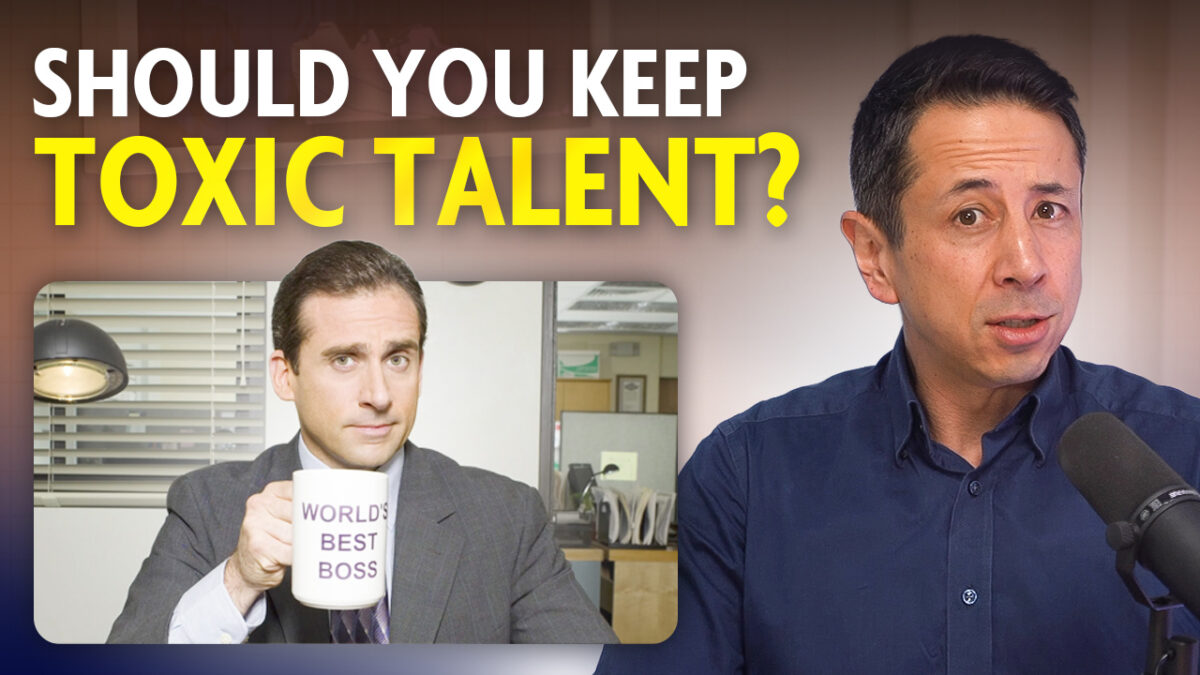
Should you fire a high-performing but toxic employee?
Listen to or watch on your favourite platform
Show Notes
Should you fire a high-performing but toxic employee?
Should you keep a high performer that everyone struggles to work with? In this episode of Lead to Grow, Tommy Sim tackles one of leadership’s toughest questions: what to do when someone delivers exceptional results but leaves frustration, tension and disruption in their wake. He separates headline performance from true net contribution, explains why strengths become shields against feedback, and shares a five-step framework for keeping the value without paying for the damage.
Listen on YouTube, Spotify, or Apple Podcasts. Episode runs 20 minutes.
The two easy answers that both fall short
Most leaders reach for one of two responses when a valuable but difficult person becomes a problem. The first is to tolerate the behaviour because the results are good. The second is to move them on because culture matters. Tommy argues that neither is good enough on its own, because anyone who has actually managed people knows the decision is rarely that clean.
“It’s not simply should we keep them or get rid of them. The better question is, can we keep the value they create without continuing to pay for the damage around it?”
Headline performance is not the same as net contribution
The first trap is calling someone a high performer just because one number looks good. A salesperson tops the leaderboard while delivery spends three weeks fixing problems they never agreed to. A technical expert solves what no one else can while making junior staff feel stupid and keeping knowledge trapped in their own head. The headline is easy to see. The real cost usually is not.
“Sometimes a person looks more valuable than what they really are because no one is measuring what they cost.”
When a strength becomes a shield
The same strength that makes someone valuable externally is often the strength they use internally to avoid the standard. The strong salesperson points to the scoreboard. The analytical person uses logic to win. The technical expert buries you in complexity. The client favourite reminds you of the relationship. Suddenly the manager is no longer talking about behaviour, they are trying to prove they understand the person’s world well enough to challenge them.
“That is the strength shield. When someone uses the thing they are genuinely good at to protect themselves from feedback.”
Don’t fight on their turf: the jujitsu reframe
If you try to win in their strongest field, you will likely lose. Instead of trading blows, Tommy suggests using the force of their own argument to move the conversation somewhere more useful. When they ask “do you want me to hit my target or not?”, the answer is not a trap to accept.
“Yes, I want the target hit and I want the target hit in a way the business can deliver repeatedly. I don’t want to make a choice between performance and standards. The question is how we do both.”
Respect the strengths, remove the exemption. That is the reframe.
The five steps to work it through
Rather than deciding from fear, frustration or a slogan, Tommy walks through a cleaner way to test whether the value can stay and the damage can reduce.
- Identify the strength and the shield. Before the conversation, work out this person’s extreme strength and how they might use it to control the room. Prepare for the real conversation, not the ideal one.
- Move from the incident to the operating model. Do not spend the conversation proving yesterday was wrong. Reframe their argument into a design brief for next time: speed without chaos, client confidence without over-promising, an escalation rule sales can use without bypassing delivery.
- Build alignment through micro-agreements. Connect the conversation to the bigger picture of a business that can scale, then stack small agreements that are hard to reasonably reject. The aim is mutual understanding, not a big admission of fault.
- Turn the agreement into if-this-then-that behaviours. Vague promises to “communicate better” are not strong enough. A standard becomes real when it tells people exactly what to do next time, written down as a shared operating standard, not a punishment.
- Follow up and review the evidence. Book the review when you make the agreement. Did they do what they agreed? Did you? The follow-up is where the agreement becomes evidence.
“A standard becomes real when it tells people what to do next time.”
The net contribution test and dependency risk
When you follow up, stop relying on feel and run the net contribution test. What did this person genuinely produce, and what did they cost that never shows up on their personal scorecard? Is the team performing because of this person or despite them? Would you tolerate the behaviour if the number was only average? If the honest answer is that you cannot challenge them because the business depends on them too much, you have found a different problem: dependency risk.
“If one person has become too valuable to manage, the business and the leader of that team has allowed value to become leverage.”
Part of the plan then becomes reducing the dependency: share the client relationship, document the process, cross-train another person, build the next layer of capability.
The real question to ask
Do not tolerate poor behaviour just because someone gets results, because that teaches everyone else the standard is negotiable. Equally, do not rush to the culturally popular answer and lose real commercial value. The best outcome is not that the person leaves. It is that they keep creating value and stop creating unnecessary cost around it.
“The real question is, can we afford to keep protecting the exception?”
Key takeaways
- High performance and high contribution are not the same thing. Measure the full ledger, not one headline number.
- Strengths often become shields against accountability. Prepare for the field the person will try to fight on.
- Don’t relive yesterday. Move the conversation to the operating model for next time.
- Micro-agreements and if-this-then-that behaviours turn a messy conversation into a clear standard.
- Follow up on the agreement. That is where value stays and damage reduces, or where you get clean evidence it cannot.
- If you cannot challenge someone because the business depends on them, that is dependency risk, and it needs its own plan.
About Lead to Grow
Lead to Grow explores the people principles behind high-performing businesses. Hosted by Tommy Sim, the podcast focuses on leadership, performance, culture and decision-making, with practical insights leaders can apply immediately.
New episodes are released regularly. If this episode helped you rethink how you weigh performance against behaviour, share it with a leader who may need it. Follow the show on Apple Podcasts and Spotify, or subscribe on YouTube for future episodes.